Import and Export of Price Templates
Manage price templates in bulk using a CSV file.
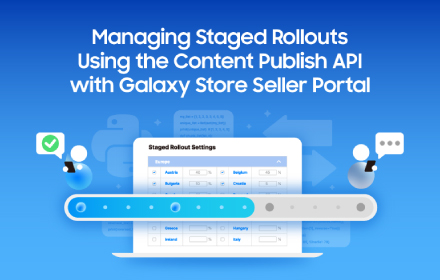
Managing price templates for multiple in-app products is now easier. You can export existing price templates into a CSV file, update them in bulk, and import the file back into Seller Portal. This lets you update existing templates or add new ones without editing each template individually.
Main Features
• Export price template information configured in the Seller Portal as a CSV file.
• Update template names, connected in-app products, standard prices, and country-specific price exceptions in bulk.
• Add new price templates by adding new rows to the CSV file.
• Import your updated CSV file directly into Seller Portal.
Before you import
We recommend exporting the latest CSV file before making changes. When you import the file, only newly added or updated price template information is applied.
Get started
Open your application in Seller Portal and navigate to In App Purchase > More > Price Template. Then select Export or Import.
Learn how to export and import price templates |
|
|
|
Samsung Wallet Brings Aliro-Based Company ID to the WorkplaceEver find yourself digging through your bag for your employee ID on the way into the office? Samsung Electronics is extending the Samsung Wallet digital key experience to commercial buildings, following its Aliro-based digital home key.
Built in collaboration with Kastle Systems and available in the U.S. and Canada, Company ID lets users store their employee ID in Samsung Wallet and enter the building by tapping their Galaxy smartphone on a supported reader — no physical card required. On select supported models, access stays available for a limited time even after the battery runs down and the phone powers off.
Security can be matched to the space: Fast Mode gets employees in with a tap alone, while higher-security areas can be configured to require biometric or PIN verification. If a smartphone goes missing, it can be locked or erased remotely through Samsung Find, reducing the risk of unauthorized access.
See how the digital key experience now runs from your front door to your office entrance — read more on our blog.
Learn more |
|
|
|
S26 FE Added to Lineup of Emulator Skins for Galaxy S26 Series
Galaxy S26 FE is the newest addition to the Galaxy S26 series. The new emulator skin for Galaxy S26 FE, offering the latest flagship experience, expands the S26 series skin lineup, letting you add the exterior design of this device to your Android emulator. These visual frames display the front bezel, punch-hole camera cutout, and side button placement around the emulator window, allowing developers to see the appearance of an actual Galaxy device while developing their applications. To use emulator skins, at least one Android SDK platform must be installed in Android Studio. Download the emulator skin for Galaxy S26 FE now and add the latest Galaxy device look to your emulator.
Learn more |
|
|
|
Samsung Wallet Integration Made Simple with Code Lab
Samsung Wallet provides developers with a single, integrated platform for payments, digital cards, and identity verification. Developers can learn how to utilize this platform for development through guided, hands-on tutorials on Code Lab. Practical topics cover the core integrations: adding Samsung Pay to a website checkout, accepting in-app payments, storing digital card information in Samsung Wallet, and verifying user identity with only a few taps. The tutorials come with walkthroughs for implementing each integration from start to finish. Each topic includes step-by-step instructions, code samples, and working examples to help with faster integration. A dedicated Flutter plugin topic is also available for in-app payment integration in cross-platform projects. Start building with Code Lab today.
Watch the video
Explore Samsung Wallet in Code Lab |
|
|
|
Game Service Termination in Vietnam
Starting September 30, 2026, the Seller Portal will no longer allow developers to add new applications or update existing applications distributed in Vietnam. From November 11, 2026, the Game tab will be removed from the Vietnam Galaxy Store, and games will no longer be available for download, updates, or re-downloads.
Please see the termination notice for more information. |
|
|
|
[Interview] The People Behind the Galaxy Z Fold8 Series’ Camera Innovations: How My FanCam Keeps Favorite People in Focus
The new Galaxy Z Fold8 series, unveiled at Galaxy Unpacked 2026, introduces My FanCam, a new feature that lets users edit videos with a focus on a person of their choice. Simply tap a person in a video, and AI recognizes their location and visual characteristics and tracks them throughout the video. Even if the person is obscured or temporarily lost in the frame, AI can find them again and complete the video with the selected person in focus.
My FanCam was developed in a close collaboration between Samsung Research, which developed the AI video tracking technology, and the MX Business Division, which implemented it on mobile devices. In particular, the teams worked together to optimize the AI model and streamline the overall processing pipeline to enable on-device processing without a separate server connection. From fan cams of your favorite artists to videos of children’s activities and your own workout vlogs, My FanCam helps you capture everyday moments with the people who matter to you. Find out the full story behind the feature's development with the developers' own voice on the Samsung Electronics Newsroom.
Learn more |
|
|
|
Immaculate Engineering Meets Artistic Imagination: Highlights From Design Miami Seoul 2026
Between the 1st and 6th of September, Samsung Electronics presented a special exhibition called “Design is an Act of Love” at Design Miami Seoul 2026, held at Dongdaemun Design Plaza (DDP) in Seoul. 14 Korean artists and design studios drew inspiration from Samsung products including mobile devices, TVs, and home appliances, interpreting them in their own artistic ways. The completed artworks were exhibited on OLED TV S95H displays, each featuring a custom frame with different materials and forms, presenting different possibilities the same product can have depending on individual tastes and identities.
Listen to Mauro Porcini, President and Chief Design Officer of Samsung Electronics’ DX Division, as he discusses the role of design in the AI era, and discover how Samsung’s human-centered design vision came together with the artists’ imaginations to expand across products and spaces in this exhibition on the Samsung Electronics Newsroom.
Learn more |
|
|
|
From Biosignals to Health Insights: Samsung Research’s Work on Health Foundation Models
Researchers from the Digital Health Team at Samsung Research America (SRA) have introduced two health foundation models that learn from wearable biosignals to deliver precise health insights. Unlike the conventional approach of developing separate models for specific purposes, these foundation models are pretrained on large-scale data and can be adapted for a wide range of health tasks from a single pretrained model. xMAE learns the temporal relationship between electrocardiogram (ECG) and photoplethysmography (PPG) signals, enabling the precise analysis of cardiovascular health features using only PPG, which is easier to measure. HiMAE analyzes wearable data across multiple time scales and produces results in less than one millisecond on a smartwatch CPU, demonstrating the potential of an on-device health foundation model for the first time. Look into Samsung Research’s wearable AI research, recognized through the acceptance of the two studies to ICML and ICLR, on Samsung Newsroom.
Learn more |
|
|
|
6G NTN: Making Mobile Networks Reachable Beyond Terrestrial Coverage
Mobile networks have traditionally been evaluated based on performance metrics such as throughput, latency, bandwidth, capacity, and coverage. However, for a hiker outside terrestrial network (TN) coverage, a vehicle on a remote road, or a user in an area affected by a disaster, the most immediate and critical need may be simply being able to establish a connection and send a short message, rather than a full broadband service. This is why non-terrestrial networks (NTN) are becoming strategically important to the mobile ecosystem.
The first phase of 3GPP-based NTN brought satellite access into mobile standards, but some functionalities were not optimally supported due to backward compatibility requirements because NTN was not designed from the beginning of NR. Samsung Research defines NTN not simply as satellite access, but as a mobile continuity layer that keeps essential services available when terrestrial coverage is unavailable, and proposes four design principles: coverage-first access, designs based on realistic device and satellite deployment assumptions, robust positioning and timing, and control that accounts for delay and mobility. Discover Samsung Research’s 6G NTN design principles enabling mobile connectivity to remain available even where terrestrial connections fail, on the Samsung Research blog.
Learn more |
|
|
|
AI-Driven Optimization of Perceived Quality at the User and Service Levels
As extended reality (XR), cloud gaming, ultra-high-definition video streaming, and multimodal AI services become increasingly widespread, maintaining consistent user-perceived quality has emerged as a key challenge for 5G-Advanced and 6G services. Analysis of commercial network data has shown that quality degradation is often not random, but instead occurs repeatedly for certain users along frequently traveled routes or in specific radio environments. However, conventional optimization features such as self-organizing networks (SON) focus on improving cell-level performance. Because cell parameters are shared by all users within a cell, adjusting them to improve the experience of a small number of users may degrade perceived quality for others.
Samsung Research proposes an AI-driven optimization framework that learns recurring quality degradation patterns and provides user-specific responses. The new framework uses multivariate time-series data, including signal strength, interference, and throughput, to identify reference patterns that characterize the conditions preceding quality degradation. It then compares these with real-time data to predict potential quality degradation in advance and proactively performs a handover only for the target user. Field evaluations of the framework in commercial mobile networks showed that connection failures for target users were reduced by up to 98.7%, while the service level agreements (SLA) violation rate also decreased from 13.1% to 7.2%. AI-driven mobility control is moving beyond reactive cell-level optimization and toward predictive intelligence at the user and service levels. Learn about this new technology on the Samsung Research blog.
Learn more |
|
|
|
|
|
|
|
https://developer.samsung.com
Copyright© %%xtyear%% SAMSUNG All Rights Reserved.
This email was sent to %%emailaddr%% by Samsung Electronics Co.,Ltd.
You are receiving this email because you have subscribed to the Samsung Developer Newsletter through the website.
Samsung Electronics · 129 Samsung-ro · Yeongtong-gu · Suwon-si, Gyeonggi-do 16677 · South Korea
Privacy Policy
Unsubscribe
|
|
|
|
|
|
|
|
|