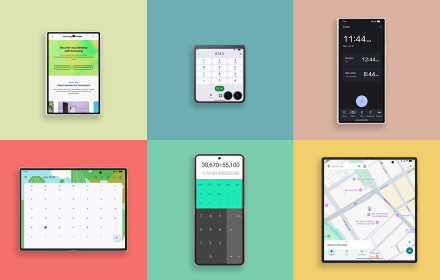
Meet the New Galaxy from "Galaxy Unpacked July 2026" in the Remote Test Lab
Test your applications on a wide range of Galaxy devices anytime, anywhere in the Remote Test Lab.
You can remotely access and test your applications on different Samsung devices, including the Galaxy S26, tablets, watches, and smart TVs. The Galaxy Z Fold8 and Galaxy Z Flip8, unveiled at Galaxy Unpacked July 2026 on July 22, are also available for quick testing in the Remote Test Lab. Developers can use Android Debug Bridge (ADB) directly through the Remote Debug Bridge (RDB) feature and run tests for application compatibility in a 16 KB page-size environment easily.
For even more benefits, join our Remote Test Lab Partner Program. Partners receive additional credits and extended usage time compared to regular users, giving them greater freedom for testing.
Use Remote Test Lab
Read News about the Latest Galaxy Unpacked |
|
|
|
Log Workout Data using Samsung Health Data SDKSamsung Health stores a wide range of health and wellness data. Samsung Health Data SDK enables applications to interact with data storage, including logging workout data back to the storage. For example, you can develop an application that logs every running session with the measured heart rate, cadence, power, and speed data and stores the workout records alongside the user's existing data in the Samsung Health application.
This Code Lab guides you through requesting write permissions, organizing a workout session with time-series log entries, combining valid data points, and submitting them to the health data storage. It also shows how to verify the stored data using the DataViewer tool and the Samsung Health application.
Learn more |
|
|
|
Building Health Apps with Multiple Types of Health Sensor Data on Galaxy Watch Using Samsung Health Sensor SDK
Galaxy Watch, running on Wear OS, features Samsung's BioActive sensor to measure health sensor data such as heart rate and blood oxygen level (SpO2) on the wearer's wrist. Samsung Health Sensor SDK lets your app measure the health sensor data you need and obtain the results, providing raw and processed data. With the SDK, you can also retrieve multiple types of health sensor data simultaneously. The following Code Labs demonstrate how to build Galaxy Watch apps using Samsung Health Sensor SDK.
Measure Blood Oxygen Level on Galaxy Watch
Measure Blood Oxygen and Heart Rate on Galaxy Watch
The Samsung Health Sensor SDK and Galaxy Watch provide a reliable foundation for building health applications that deliver meaningful measurement results to your users.
Learn more about Samsung Health Sensor SDK |
|
|
|
Galaxy Store's IAP Management, Now Supported on Third-Party Payment Platforms
Samsung In-App Purchase (IAP) for Galaxy Store is now supported by third-party subscription and in-app purchase management platforms. These solutions simplify multi-store distribution by integrating Galaxy Store purchases alongside other app stores through a unified SDK.
Most notably, RevenueCat, a subscription and in-app purchase management platform, now officially supports Samsung IAP. Developers already using RevenueCat can add Galaxy Store as a distribution channel with minimal additional configuration. Once set up, all RevenueCat features including Offerings, Paywalls and Entitlements work the same way they do for other supported stores.
Galaxy Store support is available for Android 10.7.0 or higher and React Native 10.3.0 or higher. Expand your app's reach across multiple stores effortlessly.
Learn more |
|
|
|
Samsung IAP Unity Plugin Updated to Version 6.5.2
The Samsung IAP Unity Plugin v6.5.2 integrates the latest Samsung IAP SDK features to provide a richer and more reliable in-app purchase experience.
This update includes support for reporting the age status of a buyer if the buyer is in a region governed by laws to protect minors, explicit acknowledgement of purchases for non-consumable and subscription products, and improved handling of IAP inquiry requests during payment transactions. The passThroughParam parameter, previously used during purchase requests, has been deprecated, and fraudulent payment detection has been improved by supporting the entry of obfuscated account and profile information when submitting purchase requests, helping provide a safer and more reliable payment environment.
Please see the Guide to learn how to integrate the latest plugin. |
|
|
|
Introduce Subscriptions for Your Games Using Samsung IAP Unreal Engine Plugin
Managing subscriptions effectively is a key part of the monetization strategy for live service games. The Samsung IAP Unreal Engine Plugin has been updated to reach feature parity with the Samsung IAP SDK, making it easier to integrate a complete subscription management workflow into your game with multiple new APIs. Checking promotional offer eligibility, purchasing and changing subscription plans, checking purchases, and more can be handled now, and the update also introduces Boolean return types to indicate whether an API call was executed successfully.
This tutorial walks you through the entire process, from setting up your development environment and adding in-app products in the Galaxy Store Seller Portal to implementing a subscription management workflow in your game. Learn more about the Samsung IAP Unreal Engine Plugin on our blog to help you deliver a more secure and complete in-app purchase experience for Unreal Engine games.
Learn more |
|
|
|
Samsung Health SDK for Android Deprecation: Time to Move to Samsung Health Data SDK
The Samsung Health SDK for Android has been deprecated as of July 31, 2025. Developers are strongly recommended to migrate to the Samsung Health Data SDK to maintain access to supported data types and utilize additional health data types such as IHRN (Irregular Heart Rhythm Notification) and sleep apnea risk detection.
We are collecting feedback to support our partners and communities better. Please participate in this quick survey and let your voice be heard here.
See the Migration Guide and Partner Request pages for detailed migration instructions. For the full list of supported data types, see the Samsung Health Data SDK documentation page. |
|
|
|
Samsung and KDDI Successfully Complete AI-Powered Network Optimization Trial on Commercial 5G Standalone Network in Japan
Samsung Electronics has successfully completed a trial of its AI-powered RAN Speed Optimizer (RSO) on KDDI’s commercial 5G Standalone (SA) network in Japan. Conducted over several months beginning at the end of the last year, the joint trial used 100 MHz of 3.7 GHz TDD spectrum across hundreds of cells spanning urban, suburban, and rural areas in and around Tokyo. During peak hours, 5G downlink throughput improved by an average of 31% across the trial area and by up to 52% in dense urban areas, demonstrating the potential of the AI-powered solution to enable more precise and adaptive network optimization in commercial environments. This allows operators to automatically adjust to changing network conditions, reducing manual intervention and improving cost efficiency. Users can experience faster and more reliable connections whether they’re streaming videos, browsing the web, or making calls. Learn more about Samsung’s AI-powered RSO innovation, which enables more precise and advanced network optimization on the Samsung Electronics Newsroom.
Learn more |
|
|
|
K-Merge: Continuous Online Merging of Adapters for On-Device Large Language Models
To run large language models (LLMs) on smartphones and tablets, developers utilize Low-Rank Adaptation (LoRA) adapters which keep the base model frozen while adding lightweight, task-specific modules to support personalized features such as email summarization and translation. As new tasks continue to arrive, however, devices can store only a limited number (K) of adapters, and privacy regulations prevent access to the original training data. When a new adapter arrives while the storage budget is already full, the device cannot save the new adapter or simply discard an existing one without suffering from catastrophic forgetting, losing the ability to perform the previous tasks.
To address this challenge, Samsung Research introduces K-Merge, a lightweight algorithm that dynamically decides which adapters to merge and how to merge them, entirely on-device. K-Merge identifies the stored adapter most similar to the incoming one by measuring distance in the weight parameter space and adjusts the merging coefficients based on merge history to prevent capabilities learned from earlier tasks from being overwritten by newer updates.
Evaluations on 1B- and 1.5B-parameter on-device models showed that K-Merge retained 80–90% of single-task LoRA performance using only eight adapters instead of forty. An advanced variant, K-Merge++, proactively merges highly similar adapters before storage runs out, making performance more robust regardless of task order. Learn more about K-Merge and how it enables on-device LLMs to continuously acquire new capabilities under strict storage constraints on the Samsung Research blog.
Learn more |
|
|
|
Building the Foundation for Global 6G Standardization: Deep Dive Into ITU-R IMT-2030 Requirements and Evaluation Guidelines
Every generation of mobile communications has begun with a bold vision that is ultimately realized through a global standard. The standardization of 6G (officially designated by ITU-R as IMT-2030) is driven by collaboration between ITU-R, which defines the overall framework, minimum requirements, and evaluation methodologies, and 3GPP, which develops the mobile communication specifications to meet those requirements. After establishing the IMT-2030 framework with six usage scenarios and 15 key capabilities in June 2023, ITU-R WP 5D laid out a four-stage roadmap toward commercial deployment by 2030.
In the second stage of the roadmap, where we are at now, the high-level framework is translated into concrete, verifiable requirements. The draft report on Minimum Technical Performance Requirements (TPRs) was completed in February 2026, defining a total of 20 metrics (14 enhanced metrics inherited from 5G and 6 new metrics supporting emerging services such as XR and AI/sensing). This was followed in June 2026 by the completion of the draft Evaluation Guidelines report, which defines 3 assessment methods of simulation, analytical evaluation, and inspection, and 7 representative test environments, to establish objective criteria for evaluating 6G candidate technologies. Samsung Research currently chairs the Sub-Working Group on Coordination (SWG Coordination) within ITU-R WP 5D, coordinating and leading the standardization process between ITU-R, 3GPP, and independent evaluation groups. Learn more about the journey toward a unified global 6G standard by 2030 and Samsung's leadership in shaping the future of 6G standardization on the Samsung Research blog.
Learn more |
|
|
|
|
|
|
|
https://developer.samsung.com
Copyright© %%xtyear%% SAMSUNG All Rights Reserved.
This email was sent to %%emailaddr%% by Samsung Electronics Co.,Ltd.
You are receiving this email because you have subscribed to the Samsung Developer Newsletter through the website.
Samsung Electronics · 129 Samsung-ro · Yeongtong-gu · Suwon-si, Gyeonggi-do 16677 · South Korea
Privacy Policy
Unsubscribe
|
|
|
|
|
|
|
|
|