Samsung Begins One UI 9.5 Beta Program
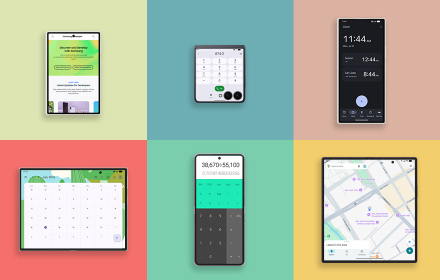
Samsung has begun the One UI 9.5 beta program, giving Galaxy S26 series users an early look at the software before its official release. The beta brings more precise camera controls with customizable Pro and Pro Video modes, App Lock for individual apps, Mindful Note in Samsung Health, and improved accessibility features such as a floating shortcut and hearing aid controls.
The One UI 9.5 beta program is open to Galaxy S26 series users in select markets, including Germany, India, Korea, Poland, the UK, and the U.S. Eligible users can apply to join the beta program through the Samsung Members app. Learn more about the One UI 9.5 beta program on Samsung Newsroom.
Learn more |
|
|
|
New Samsung Health Accessory SDK v3.3.0 ReleasedThe Samsung Health Accessory SDK has been updated to v3.3.0. This release improves the usability and test coverage of the Verification Tool to allow Samsung partners to conduct their self-verification more systematically. A new device type is also added, bringing the total number of supported device types to 10.
Key improvements:
-
Treadmill has been added as a new device type, expanding verification coverage for home fitness devices.
-
Broader test coverage and more systemized test cases make it easier to review verification items more clearly and conduct a more complete self-verification.
-
The Verification Tool UI has been redesigned to enable a more intuitive user experience.
-
The Verification Tool user manuals for each device have been revised thoroughly for a smoother self-verification experience.
Please see the following links for more information: |
|
|
|
Samsung Wallet Launches Hotel Key with EntryReady
Samsung is introducing Hotel Key in Samsung Wallet, in collaboration with EntryReady, a hospitality access-control provider. Starting in November 2026, guests at participating hotels in the United States can add their reservation card to Samsung Wallet and receive their room key automatically at check-in. From there, they can open the room simply by holding their Galaxy smartphone near the door lock. When guests check out, the key is removed automatically, so access stays limited to the stay itself, while the card remains in Samsung Wallet as a record of the visit.
Guests can also bring their reservation card and Hotel Key together with other travel items in Samsung Wallet, such as boarding passes, car rentals, and activities, in a single Trips timeline to see their whole journey at a glance. For hotels already integrated with Samsung Wallet, hotel content can also appear in the Trips timeline without any additional development. Hotels that use EntryReady can contact EntryReady to learn how to offer Hotel Key in Samsung Wallet to their guests.
Read the blog to learn more about Samsung Wallet Hotel Key, which connects every step of the stay, from booking and check-in to room access and checkout.
Learn more |
|
|
|
Design and Preview Wallet Cards Faster Using Samsung Wallet Studio's "Playground"
You can now preview wallet cards using Samsung Wallet Studio's Playground feature before writing any integration code. Partners can choose from pre-configured card types including boarding pass, event ticket, coupon, gift card, and loyalty card, and see the card design updated in real time with every edit.
Field values can be edited on the form or using JSON, and the updated card data is reflected immediately. Click the "Add to Samsung Wallet" button to add the card to your Samsung Wallet app, which is supported by scanning a QR code on desktop. Watch our quick tour video on YouTube Shorts, then try out the Playground in Wallet Studio yourself! |
|
|
|
Automate Your Application Deployment Using the Galaxy Store fastlane Plugin
Tired of manually uploading binaries and copying and pasting release notes for each app store? If you are already using fastlane and supply for Google Play, you can extend your existing setup to Galaxy Store in mere minutes with the Galaxy Store fastlane plugin. Learn how to automatically import your Play Store metadata from supply, upload AAB/APK binaries, manage staged rollouts, and trigger end-to-end deployments using GitHub Actions and the Galaxy Store fastlane plugin. Check out the tutorial on our blog to learn more.
Learn more |
|
|
|
Samsung Gallery Makes It Easier to Access Photos and Videos Across Galaxy Devices
Samsung Electronics offers a Gallery sync service in collaboration with Google, making it easy to access photos and videos across multiple Galaxy devices through Samsung Gallery and Google storage. Getting started with the service is simple. With your Samsung and Google accounts set up on your device, you can enable sync in Gallery without creating a separate cloud account. When setting up a new Galaxy device, sign in with the same Samsung and Google accounts used on your previous device to see previews of your photos and videos. You can select and download individual files whenever you need the originals. If you need to free up storage, use the "Free up space" feature to remove the original files from your device while keeping thumbnails visible in the Gallery and the originals stored in Google storage. Gallery sync is available on select Galaxy devices running One UI 9, with the gradual support rollout planned for additional devices. Learn more about the sync service, which makes it easier to store your photos and videos more securely across Galaxy devices.
Learn more |
|
|
|
Systematic Probabilistic Shaping: A Practical Path to More Efficient Wireless Networks
Data modulation in cellular systems has evolved primarily by increasing the number of signal points available in quadrature amplitude modulation (QAM). But conventional QAM, which uses each point with equal probability, falls short of the theoretical capacity of a channel with additive white Gaussian noise. In such a channel, a continuous Gaussian input achieves the highest possible information rate for a given average transmit power. Constellation shaping, which aims to narrow this gap, was a prominent topic in 3GPP RAN1 during the 6G study phase. One approach, probabilistic shaping, keeps the same constellation layout and sends lower-energy points more often. Applying it to high-speed links requires keeping the extra processing from limiting throughput and ensuring that the intended probabilities are reflected in the transmitted signal after error-correction coding.
To address these challenges, Samsung Research proposes Systematic Probabilistic Shaping (S-PS), which combines selective probabilistic shaping with the existing 5G coding and modulation architecture. S-PS shapes only one bit in each of the signal’s two components. It positions those bits so that they retain their values through coding and reach the intended positions in the modulation mapping. This limits the extra processing while allowing the core 5G coding and modulation steps to be reused. In Gaussian noise evaluations across several high-order QAM configurations, S-PS achieved higher spectral efficiency than uniform QAM at the same signal-to-noise ratio. In selected configurations, it reduced the signal-to-noise ratio required for the same spectral efficiency by up to about 1.5 dB. Learn more about S-PS and its potential for applications that need high data rates within limited spectrum, such as fixed wireless access (FWA) and wireless backhaul, on the Samsung Research Blog.
Learn more |
|
|
|
CG-TTRL: Context-Guided Test-Time Reinforcement Learning for On-Device Large Language Models
Large language models (LLMs) are increasingly expected to handle complex, multi-step reasoning directly on users’ devices. However, their capabilities are largely fixed to the point when they are deployed. Test-time reinforcement learning (TTRL) improves a model without labeled data by rewarding it when its answers agree with its own majority vote. However, if the majority vote turns out to be incorrect, it can actually reinforce flawed reasoning. This problem is particularly likely to occur with small on-device models, where individual samples are less reliable. Adding poorly chosen examples to the prompt can deteriorate performance, while sophisticated selection methods typically require auxiliary models or expensive computation.
In response, Samsung Research proposes CG-TTRL, the first framework to integrate in-context learning (ICL) into an unsupervised test-time fine-tuning pipeline. CG-TTRL uses TF-IDF features to retrieve similar examples from a context pool. As these features require only simple counting operations, context selection can be performed efficiently without an additional model on the device. The retrieved examples are reused in both exploitation and exploration phases, as well as during final inference to improve the accuracy of majority votes. Evaluated on 5 reasoning benchmarks using three different 1.5B-parameter models, CG-TTRL achieved the best average accuracy across all three models. After a single epoch (which corresponds to 3 update steps), CG-TTRL raised average accuracy from 48.9% to 53.0%, outperforming TTRL, which reached only 49.5%. Learn more about CG-TTRL on the Samsung Research blog.
Learn more |
|
|
|
|
|
|
|
https://developer.samsung.com
Copyright© %%xtyear%% SAMSUNG All Rights Reserved.
This email was sent to %%emailaddr%% by Samsung Electronics Co.,Ltd.
You are receiving this email because you have subscribed to the Samsung Developer Newsletter through the website.
Samsung Electronics · 129 Samsung-ro · Yeongtong-gu · Suwon-si, Gyeonggi-do 16677 · South Korea
Privacy Policy
Unsubscribe
|
|
|
|
|
|
|
|
|